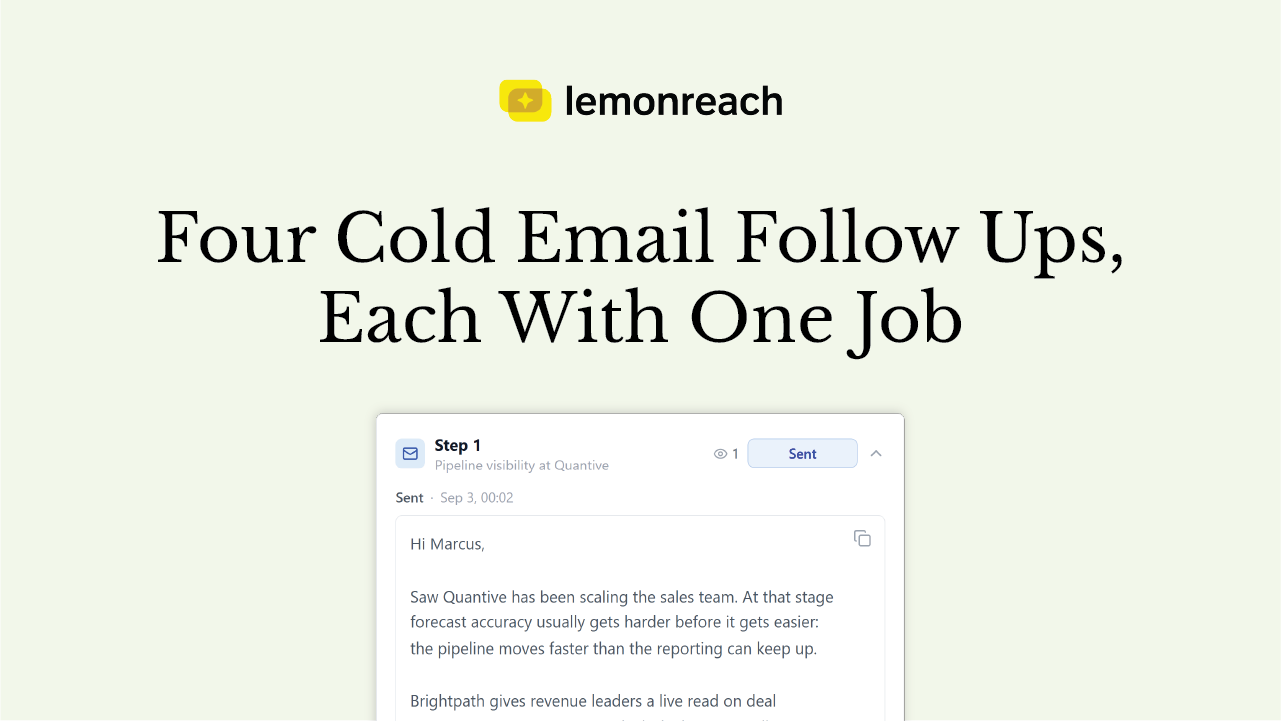
A good cold email sequence is one initial email plus four follow-ups, sent on day 3, day 6, day 12 and day 20. Each follow-up has one job: a quick bump, a value add, a case study and a polite breakup. Stop after the breakup unless the prospect has engaged, because every extra touch after that tends to cost more in spam complaints and unsubscribes than it earns in replies.
Which follow-up cadence should you run?
Pick a cadence based on how warm the list is and how big the deal is.
- Short: one follow-up. For warm lists like webinar attendees, guide downloads or customer referrals. They already know you, so one nudge a few days later is usually enough.
- Standard: four follow-ups. The default for cold lists. Twilio recommends the first follow-up 3 to 5 business days after an unanswered message, and Grammarly cites 5 to 7 touchpoints over 2 to 3 weeks as a common range for sales. Four follow-ups ending around day 20 sits right in that range.
- Extended: more touches. Only for high-value accounts, and only if each extra touch has a new reason behind it, like a new hire or a funding round. The Belkins cold outreach benchmarks show that five or more follow-ups bring diminishing returns and higher unsubscribe and spam rates. If you go long, switch channels instead of sending more email.
The standard sequence looks like this:
- Day 0: initial email. A specific reason you picked this person, and one ask.
- Day 3: quick bump. Two or three lines and one question.
- Day 6: value add. An idea, benchmark or resource they can use without talking to you.
- Day 12: case study. One result from a company like theirs.
- Day 20: breakup. Close the thread and make replying easy.
What should every follow-up contain?
Every follow-up needs four parts:
- Subject line. Under 60 characters, so it isn’t cut off on mobile.
- Context. One sentence reminding them who you are and what you wrote before.
- Something new. A number, a resource, a result or a question about their priorities.
- One ask. A short call on Thursday, or a yes or no on whether this is a priority.
Aim for 50 to 125 words. That leaves room for a reminder, one idea and an ask.
The most common mistake is repetition. If a follow-up just rewords the first email, the reader has no reason to answer now when they ignored it last time. Before you send, ask what this email gives them that the previous one didn’t. A CFO might respond to a cost argument on touch two and a risk argument on touch four, but would ignore both if they read like copies of the original pitch.
A practical habit: write the ask first, then build the email around it. If you can’t state the ask in one sentence, the email isn’t ready.
Which subject lines work for follow-ups?
A follow-up subject line has to get opened and look relevant, not like an automated reminder. These patterns do both without falling back on “just following up”:
- “Quick idea for [Company]”
- “[Referral name] suggested I reach out”
- “Re: [original subject]”, for the first bump only
- “Is [pain point] a priority this quarter?”
- “Still relevant for [Company]?”
Open the email with something specific or useful. “Saw [Company] opened a second warehouse in Rotterdam” beats “I wanted to circle back”. The benchmark data shows many campaigns get a spike in replies on the second touch, so give the day 3 bump your best subject line.
Follow-up templates you can copy
Replace the brackets with real details before you send. If you don’t have real details for a bracket, rewrite the line instead of leaving it generic.
1. Quick bump (day 3)
Hi [First name], I wrote on [day] about [specific problem tied to their role]. Is this something you’re looking at this quarter? If a short call works, I can do [two time options]. Thanks, [Name]
2. Value add (day 6)
Hi [First name], while looking at how teams like [Company] handle [process], I came across [benchmark, checklist or short article]. Thought it might help with [specific goal]. If it’s useful, I can show how [similar company] approached it. Worth a short call?
Useful means something they can act on without you: a template, a number to compare against or a short teardown.
3. Case study (day 12)
Hi [First name], [Similar company] had the same [pain point] and got [one result, like hours saved or meetings booked] after [what they changed]. Happy to share how it worked and whether it fits [Company]. Open to a quick call on [day]?
Pick one metric the buyer cares about. Three metrics read like a brochure.
4. Breakup (day 20)
Hi [First name], I haven’t heard back, so I’ll assume the timing is off and stop reaching out. If [pain point] becomes a priority, just reply “later” and I’ll check back in a few months. All the best to you and the team at [Company].
Some prospects reply here simply because the pressure is gone.
Optional: new angle
Hi [First name], I may have been pitching the wrong problem. Instead of [original hook], I suspect [Company] cares more about [new hook based on a hire, launch or funding round]. Is that closer to the mark?
Swap this in for the value add when a fresh trigger appears. It invites a correction, which is often an easy thing to reply to.
Writing details like these by hand for every prospect is slow, which is the problem lemonreach sequences are built to solve.
How do you keep follow-ups out of spam?
Extra follow-ups only help if they land in the inbox. Gmail’s sender guidelines tie high spam complaint rates and repeated bounces to damaged domain reputation, which hurts every email you send afterwards. In practice:
- Verify before you send. Bounces are the fastest way to hurt a new domain. lemonreach prospecting verifies work emails before they enter a sequence.
- Warm up new domains and mailboxes, and increase volume gradually.
- Spread volume across days and mailboxes instead of sending to the whole list at once.
- Honor unsubscribes immediately, and make the option easy to find.
- Pull back when the numbers get worse. If spam or unsubscribe rates climb, shorten the sequence before you rewrite the copy.
Other channels help too. A LinkedIn profile view the day before a follow-up, or a call after the case study, gives prospects another chance to recognize your name. And if something changes on their side, like a visit to your website or a new hiring push, that belongs in your next touch. lemonreach monitors watch for those signals.
How do you measure and improve follow-ups?
Track these per touch, so you can see where prospects respond and where they drop off:
- Reply rate, split into positive, neutral and negative.
- Meetings booked, the number that actually matters.
- Spam complaints, unsubscribes and bounces, your early warning that something is off.
Treat open rates as a rough signal only. Expect a spike on the second touch and fewer replies after that. If replies flatten after the first two emails, the copy of touches three and four is probably the problem, not the length of the sequence.
Test one thing at a time: two subject lines on the day 3 bump, a specific ask (“Thursday at 2pm?”) against an open one, or email only against email plus a LinkedIn view. Keep the winner as your new baseline.
Why the best sequence is rarely the longest
A lot of follow-up advice treats it as a test of persistence. The evidence points the other way: replies fall as touches pile up, and longer sequences carry more spam risk. Put your effort into the early touches and tighten your targeting before you lengthen the cadence. A smaller list getting four different, useful emails usually beats a big list getting the same pitch four times.
If you change one thing this week, delete every touch in your current sequence that adds nothing new.
How lemonreach helps
Writing a different, personal follow-up for hundreds of prospects is where most sequences stall. lemonreach handles that work in one place:
- AI prospecting that finds contacts matching your ICP, with verified work emails and phone numbers.
- Enrichment that adds LinkedIn and news context to every lead, so each follow-up has something real to say.
- Sequences across email, LinkedIn and calls, written for each prospect in their own language, with many languages in a single campaign.
- Monitors that flag website visits, hiring, company posts, news and technology changes.
Want to see it on your own list? Book a demo, or compare plans on the pricing page.