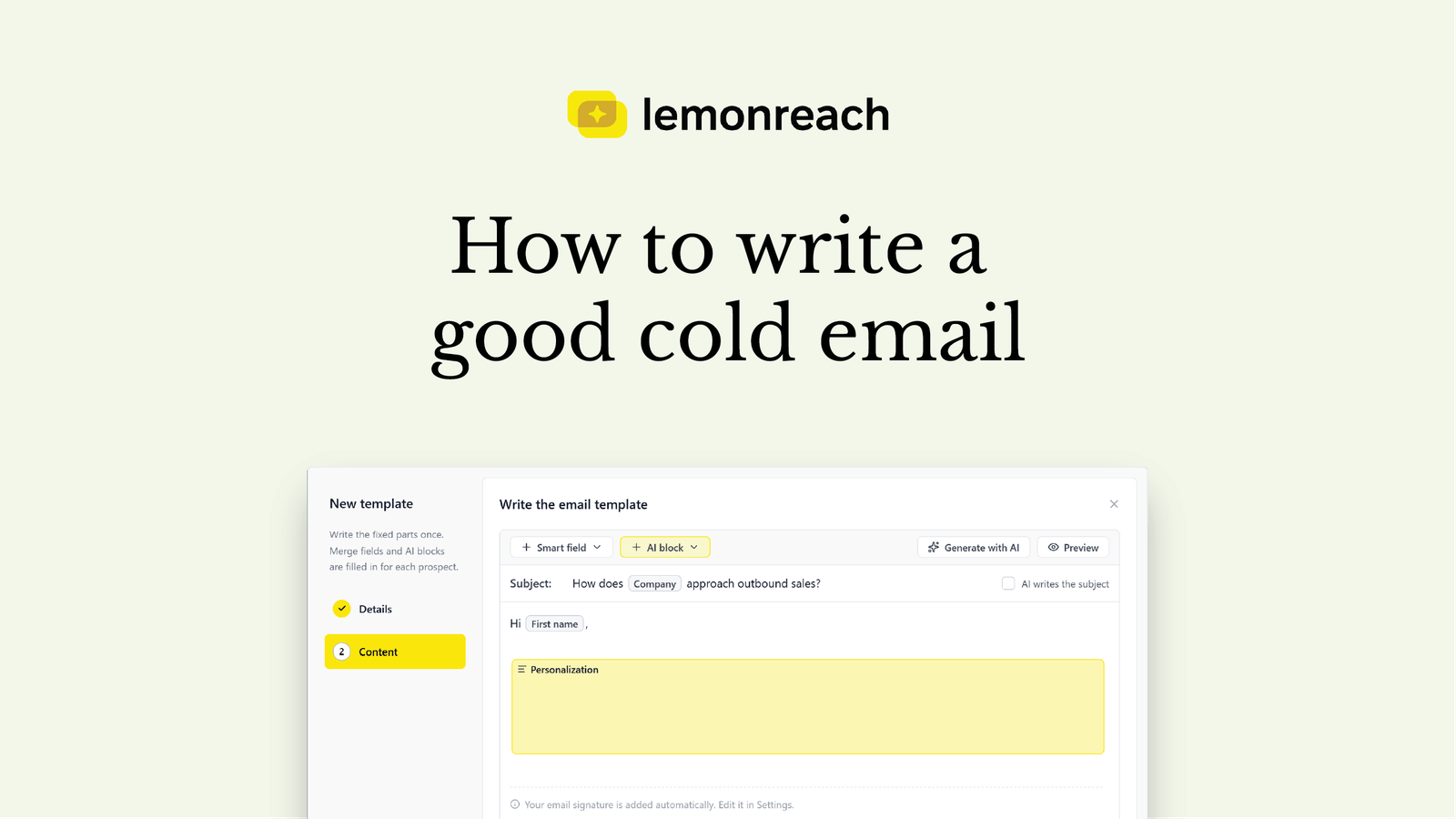
A good cold email has four parts: a subject line that looks like an ordinary internal email, one sentence of relevance that shows why you are writing to this particular person, one concrete benefit and one simple question that can be answered in a word. Keep it between 50 and 125 words and write like a colleague, not like a salesperson trying to convince. The rest of this guide covers each part, gives three complete examples, lists the most common mistakes and shows how to measure whether it works.
What four parts should a cold email have?
Most cold emails that get ignored don’t have a bad product behind them. They are missing one of these four parts.
1. Subject line
The subject line has one job: get the email opened. Write it so it resembles an email from a colleague.
- Under 60 characters, so it isn’t cut off on mobile.
- Specific. A company name or a concrete topic beats a general promise.
- No sales language. No capital letters, no exclamation marks and nothing like “Double your sales”.
Examples that work: “Hiring two sales reps at [Company]”, “Question about your logistics in Chicago”, “[Name] suggested I reach out”.
2. Relevance
The first sentence should answer “why me?”. Without it, the reader treats the email as a mass mailing. Relevance can be a hire, a newly launched service, an article they wrote, a mutual contact or something that changed in their industry.
Never open with “My name is X and I work at Y”. That is about you. Open with something that is about them.
3. Benefit
The next part says what the recipient gets from reading on. A benefit is not a feature list. It is a result or a solution to the problem the relevance line pointed to: hours saved, fewer manual steps, shorter lead time, a case study from a similar company.
Stick to one benefit. Three benefits read like a brochure and make it harder to reply.
4. One simple question
End with one question that can be answered quickly. “Is this something you’re looking at this year?” or “Should I send a short description?” works better than “Do you have 30 minutes next week for a demo?” in a first email. The less you ask for, the easier it is to say yes.
A practical habit: write the question first and build the email around it. If you can’t state the question in one sentence, the email isn’t ready.
How should a cold email sound?
Buyers react to the same things everywhere, but what works is almost always more restrained than the loud, high-energy templates that circulate online.
- Keep it informal. “Hi Anna,” is enough. Skip stiff salutations and three-line sign-offs.
- Keep the claims modest. “We help you double your growth” reads as advertising. “We shortened lead time for three logistics companies” reads as information.
- Be direct. Say what you want in the first paragraph. Recipients appreciate knowing why you’re writing without detours.
- Write in the language each prospect works in. An email in the wrong language signals a mass mailing. That holds for multi-country campaigns too. Sequences in lemonreach can write each email in the prospect’s own language, with many languages in a single campaign.
Three complete examples
Replace the brackets with real details before you send. If you don’t have a real detail for a bracket, rewrite the line instead of leaving it generic.
Example 1: The trigger is a hire
Use this when you see a company growing or building out a function. The relevance is a fact you can point to.
Subject line: Hiring two sales reps at [Company]
Hi [First name],
I saw that [Company] is hiring two new sales reps in Chicago. When a team grows that fast, the time new reps spend finding the right customers often becomes a bottleneck.
We help sales teams get a ready-made list of verified decision makers and personal first emails, so new reps can start booking meetings in their first week.
Is that something you’re looking at ahead of the hires?
Regards, [Name]
Why it works: The relevance is concrete and checkable. The benefit is a result (meetings in week one), not a feature. The question can be answered with a yes or a no.
Example 2: The reference is a similar company
Use this when you have a case study from the same industry or size. Buyers trust results from a company they recognize more than your own words.
Subject line: How [Reference company] cut its lead time
Hi [First name],
[Reference company], which like [Company] works in [industry], had the problem that [concrete problem]. After they [what they changed], [metric, for example lead time] went from [before] to [after].
I think something similar could work for you, but I don’t know whether the problem exists at all. Does it sound familiar?
Regards, [Name]
Why it works: The reader gets a number to compare against. “Does it sound familiar?” is easy to answer and lowers the threshold, because you admit you don’t know for sure.
Example 3: The short question
Use this when you have no trigger but a clear idea of who owns the problem. The email is short and only asks to be pointed to the right person.
Subject line: Question about [area] at [Company]
Hi [First name],
I’m trying to find the right person at [Company] who is responsible for [area, for example customer onboarding]. Is that you, or can you point me in the right direction?
We help companies like [Company] with [short benefit in half a sentence], but I want to know first whether it’s relevant.
Thanks in advance, [Name]
Why it works: You ask for a small favor, not a demo. Even someone who isn’t the right person can answer and point you onward, which often gives you a better contact than you started with.
What common mistakes should you avoid?
These are the mistakes that most often lower reply rate, and what to do instead.
- You open with yourself. “We are a leading company in…” tells the recipient nothing. Open with something about them.
- You ask several questions. Then the recipient answers none. Stick to one.
- The email is too long. Past 125 words it gets hard to read on a phone. Instantly cites 50 to 125 words as a range that goes with higher response.
- The personalization is fake. “I saw your profile and was impressed” isn’t relevance. A concrete fact is.
- You send to the wrong person. A good email to the wrong role is still a bad email. Spend time finding whoever owns the problem.
- You skip verification. Bounces damage your domain reputation. lemonreach prospecting verifies work emails before they enter a sequence.
- You send only one email. Belkins’ follow-up data shows that follow-ups account for most of the replies in a sequence. See our guide to four follow-ups.
- You make it hard to say no. Add a simple line where the recipient can ask you to stop. It protects both your reputation and your domain.
How do you measure the results of cold outreach?
Measure three things per campaign, and ideally per step in the sequence.
- Reply rate. Replies divided by delivered emails, with hard bounces removed. Instantly defines reply rate the same way.
- Positive reply rate. The share of replies that are interested or qualified. A “stop sending” counts as a reply but not as success.
- Meetings booked. Meetings divided by delivered emails. This is the number that decides whether a campaign pays off.
A worked example: you send 1,000 emails and 20 bounce. That leaves 980 delivered. If you get 49 replies, the reply rate is 5 percent. If 20 of the replies are positive and 8 turn into meetings, the meeting rate is just over 0.8 percent.
Keep an eye on the warning signals too: Instantly says bounces should stay under 2 percent and spam complaints under 0.3 percent. If they move the wrong way, lower the volume and check list quality before you rewrite the copy.
As a rough guide, Instantly describes 5 to 10 percent reply rate as good for B2B and above 15 percent as top level on tight segments. The 2025 Belkins benchmark sits in the low to mid single digits. Compare against your own earlier campaigns where you can, because audience and offer matter more than anything else.
Test one thing at a time, for example two subject lines or a specific question against an open one, and keep the winner as your new baseline. For more on what to track per follow-up, and how to read the curve across steps, see the guide to cold email follow-ups.
How lemonreach helps
Writing your own relevant email for every prospect is where most campaigns stall. lemonreach brings the work together:
- Email templates that mix your own text with AI-generated parts. You write the parts that should be exactly yours, such as the subject line, the offer and the closing question, and let AI write the parts that should be unique to each recipient, such as the relevance sentence. The template is saved and reused, but every email comes out personal.
- AI prospecting that finds contacts matching your ICP, with verified work emails and phone numbers.
- Enrichment that adds LinkedIn and news context to every lead, so the first sentence has something real to say.
- Sequences across email, LinkedIn and calls, written in each prospect’s own language.
Want to see it on your own list? Book a demo, or compare plans on the pricing page.